

Bordeaux Métropole

At Bordeaux Métropole, the voluntary drop-off collection center manages approximately 3,000 collection points across 21 municipalities. Three teams work side-by-side—collection, maintenance, and cleaning—with collection handled in-house, supplemented by an external contractor when staffing levels are low. Sonia Salignere has managed this center since November 2023, a few months after the rollout of UNICO.
In parallel, the metropolitan area is developing collective composting using two models. In the first, known as semi-autonomous, residents request a composter for their building; the metropolitan authority provides training and support, then leaves them to manage the site themselves. In the second, professionally managed model, the metropolitan authority installs the composters in public spaces, and residents simply drop off their bio-waste, with maintenance handled by an in-house team and contractors. Tony Pebarthe leads this second model in the municipalities located beyond the ring road, and it is for this service that the metropolitan authority turned to UNICO.
Sarah Reigner acts as the bridge between these roles and UNICO. As a project manager in the IT, quality, and data department, she leads the UNICO project and supports the collection and composting teams, both in the deployment of the tool and in the evolution of their business processes.
Before UNICO, voluntary drop-off collection relied on paper and the experience of the agents, some of whom had been running the same routes for over ten years. "Agents would head out with maps and sheets of paper, and they would return with sheets of paper containing handwritten results," says Sonia Salignere.
Tracking the tonnage or fill rate of a collection point therefore required a significant amount of research. When a municipality called to find out if a specific point was filling up, "we had two options: either we went to see the regular driver and asked him, or we took all the paper sheets from the last few weeks or months to find the fill rate noted by the driver in the box, which we then transferred to Excel." Fleet management worked the same way: when a crane operator reported a collection point out of service on their sheet, the supervisor had to go through the day's sheets in the evening, update the sector's Excel file, and print it out for the following week.
Agents had even developed their own tricks for passing on routes. Each person would leave with a sheet listing the numbers and addresses of the collection points, accompanied by a map, and an agent discovering a new route would be accompanied by a colleague or rely on their own notes.
When the public contract for the old system expired, Bordeaux Métropole put its tools out to tender. UNICO won one of the lots, notably for its ability to evolve with the organization while being built on a solid foundation of collection tracking and the ability to propose optimized routes based on fill rates.
"What struck me about UNICO is its ability to adapt to our business and our organization, because we don't all operate the same way," explains Sonia Salignere. "It was understood that we would go back and forth for at least a year, I believe, so that it would best match our reality on the ground. It’s not us getting used to the tool; it’s the tool adapting to the activity."
A margin of adaptation that she considers "beneficial" and that the team still uses regularly.
Data transfer took place between November and December 2023. The first few weeks were used to map out sectors in the tool, with supervisors learning how to build and modify a sector or schedule a route. Pilot agents tested the tablets for a few weeks, and the center went live in early 2024, about a month and a half later.
This rapid start forced the team to quickly build new processes, as the center manager explains: "We develop, deploy, and operate directly. This meant that all of a sudden, we had a massive amount of data coming in that we didn't necessarily know how to process because our workflows weren't in place." For a time, agents even continued to note everything on paper in parallel, just to be safe.
As the team discovered the tool's capabilities, they had to decide what information needed to be reported from the field and how to handle it. An agent can report a broken collection point by creating an event on their tablet, but who then handles that report, when, and with what impact on collection?
"We worked a lot on business processes," summarizes Sarah Reigner. "We all needed to have the same way of operating when faced with the same situation. Everything had to be processed: who does what, and when." This work was done through discussions with UNICO every week or two, depending on the period, starting from field practices to find, in each case, how to keep a record of them in the tool.
Paper took a long time to disappear for another reason: the contractor brought in for support did not necessarily use UNICO, meaning that a whole part of the activity, starting with collection point reports, continued to be entered by hand. The center relies on them much less now. A contractor in charge of cleaning still works on Excel files, and everyone is being encouraged to switch to UNICO. Sonia Salignere offers this advice to other local authorities starting out: "You have to think about it when choosing this solution: who will the other users be?"
Then there is the support for the agents, who had to switch to tablets even though they were used to writing down their collection data by hand at the end of their route. "Suddenly, their activity became very visible," observes Sonia Salignere: duration and pace of work, number of lifts, tonnage per route. This is valuable information for management, but a real change for the teams, which not everyone welcomed in the same way.
This year, glass collection routes were completely overhauled in UNICO with the team's support. They went from 46 to 30, with each route covering more collection points, resulting in reduced operating costs even as glass disposal sites changed.
For this stream, agents now head out without a collection sheet. They still carry a paper printout from the tool as a backup, but they no longer note fill levels or breakdowns on it: almost all events are now reported via tablet.
What used to require searching through weeks of archives is now found directly in the tool: "We’ve saved a huge amount of time in knowing how a collection point is performing, how it’s evolving, and if it’s out of service." Every week, the center can generate a report of all points flagged as malfunctioning by the crane operators; these reports trigger tracked maintenance actions, and repair requests are sent out faster than before.
"What I would say is that we’ve gained in responsiveness," says Sonia Salignere. "Today, we know how to create reinforcement routes, for example by grouping together all the points that weren't collected during the day. It has improved our service efficiency, that’s a fact." Since data is easily extracted, reorganizing a route, creating a new one, or setting up a reinforcement for uncollected points has become much simpler.
UNICO wasn't initially designed as a fleet management tool, but it is now the center's only tool for managing its collection points. "In the end, we also use it to manage our maintenance and to carry out cleaning actions and track them, because those are the three teams present in the center," acknowledges Sonia Salignere. Maintenance agents head out with the UNICO tablet and log their interventions there, which avoids having a second database and a second piece of software that would overlap with the first.
The tool was also used to deploy a new fleet: last year, the team in charge of food waste bins used it to install all of their units, each tracked from "project" status to commissioning, and then until its integration into a collection route, including maintenance checks. All streams collected via drop-off points are now tracked in UNICO: household waste, recyclables, glass, and bio-waste.
"There are a lot of us looking at our center's results on UNICO; it’s not just the center that’s interested in it," notes Sonia Salignere. The user relations department views activity directly in the tool and handles some resident requests themselves, whereas previously they had to contact the center and wait for them to find the information. Other teams also rely on these results to launch new initiatives or communicate with users.
UNICO data also feeds the metropolitan area's open data portal. "As a local authority, we are required to make our data available to users or anyone else," reminds Sarah Reigner. Thanks to this interface, every site registered in UNICO appears on the map published on the Bordeaux Métropole website, and residents can see if there is a drop-off point or a composter near them.
In the field, it is for new arrivals and temporary staff that the guidance makes the biggest difference. Each agent is responsible for four routes, and permanent relief staff can be sent to any of the 75 routes, especially during holidays. Where a new team member once had to spend three hours with a colleague to learn a route, they can now find their collection points without that prior training.
The quality of the route mapping does the rest. During holidays, when colleagues take over the routes of those absent, the difference is visible when a route has been reworked in UNICO with management, with precise instructions such as a mandatory passage through a specific street: "You can feel the real added value when a route is well-mapped; it really makes collection easier."
As with any guidance system, the driver's expertise remains essential in a metropolitan area where neighborhoods spring up before they exist on maps, and where streets change direction, widen, or are landscaped. For Sonia Salignere, the whole point is to combine both. The driver retains control to bypass an obstacle if necessary, and UNICO allows these field realities—such as a street under construction or an impassable route—to be reported back to adjust the routes over time.
The second project carried out with UNICO started from scratch. For its semi-autonomous model, the metropolitan area uses software dedicated to composting that is open to residents, but everything there is done via free-text entry: "When we do data reporting, it’s text, so it’s complicated," explains Tony Pebarthe. This tool was not adapted to the new professionalized management project.
With Sarah Reigner, Tony Pebarthe therefore adapted UNICO, software designed for collection, to an activity that follows different rules. "Here, we are no longer talking about collection; we are talking about managing material that is maturing," emphasizes Sarah Reigner. A drop-off composter, where residents deposit their bio-waste, then becomes a maturation composter and remains untouched for about six months while the compost matures, and this life cycle had to be translated into the tool.
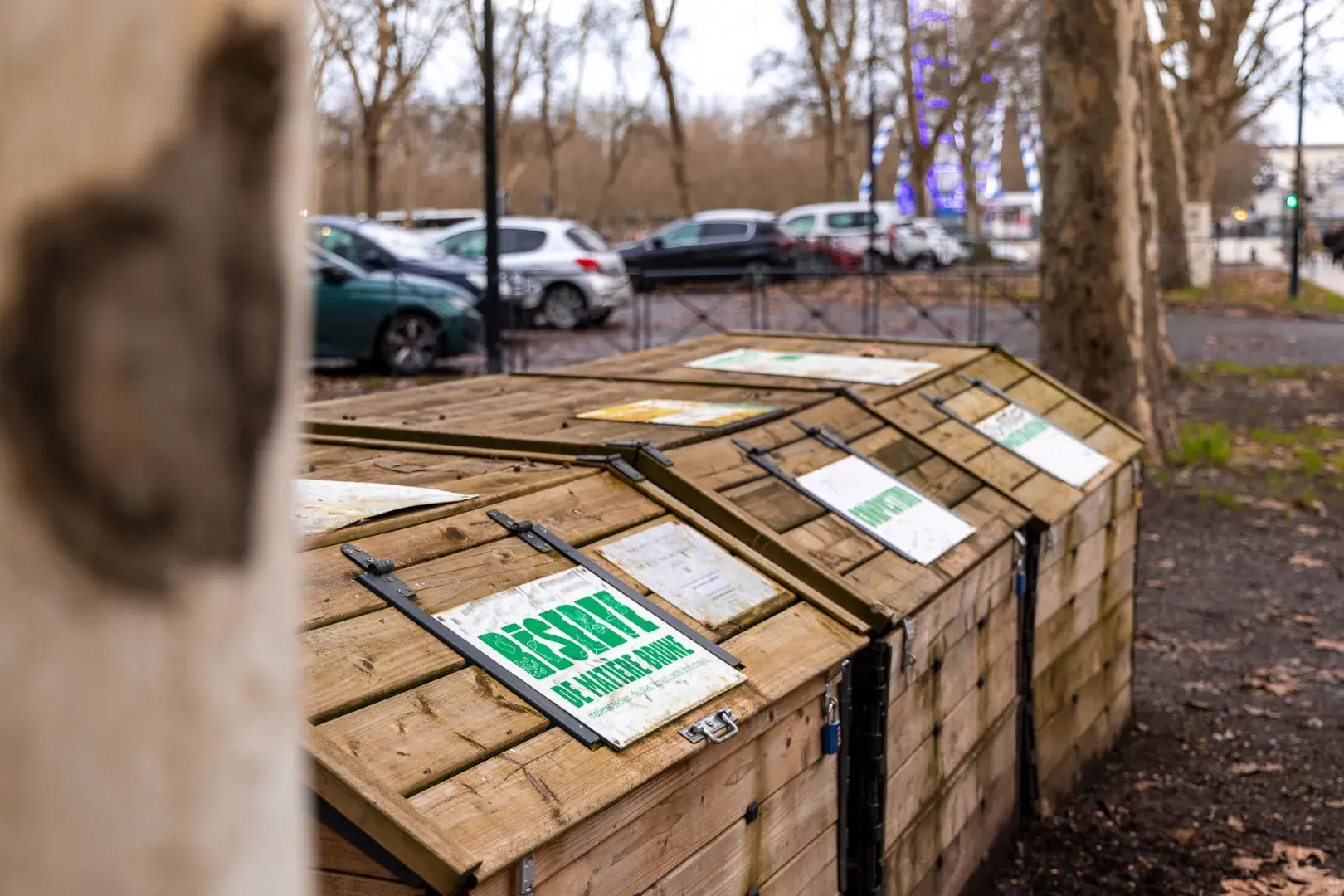
Today, all site operations are tracked: repairs, compost turning, and other maintenance routines, wood chip deliveries to refill the reserve, the addition of a bin, or compost distribution to residents. To measure maturation time, the team even leveraged the tool's collection logic: when residents pick up finished compost, the emptied bin is "collected" in the app, which provides the time elapsed between the "compost ready for collection" alert and its actual removal.
"I know both software programs well, and I can really see the difference in data reporting," says Tony Pebarthe. "It’s software designed for collection, not composting, so there are some things we can't change, and we have to adapt to that. But we’ve adapted it well, and we’re now able to track everything we do."
In the field, the team—consisting of nine in-house staff and three contractors—shares the workload across the municipalities. Contractors have restricted access to UNICO to enter their route data and also find the tool useful. The team has created numerous tutorials, formalized its processes, and trained both staff and contractors multiple times, with Tony Pebarthe providing daily oversight to ensure everyone follows the procedures.
This rigor addresses a specific challenge. For a newly launched service, management needed performance indicators, starting with the tonnage diverted from landfills, which is also used to justify the service to ADEME. After a few data entry errors at the start, there are now only "two or three minor mistakes," mostly due to inattention. "I think there’s been an improvement; it’s quite positive," summarizes Tony Pebarthe.
Regarding voluntary drop-off points, the next major project concerns household waste and recycling routes. The former are generally short, while the latter are sometimes too long. The idea is to have fewer household waste routes and more recycling routes for a roughly equivalent number of circuits, while taking into account new neighborhood developments and changing tonnage volumes. This requires analyzing routes over several weeks and comparing them (number of stops, average mileage, tonnage trends).
UNICO is also developing features with the metropolitan authority that will provide an overview of all theoretical routes, which should arrive soon. The goal, as Sonia Salignere puts it, is "to have the ability to redesign our routes based on UNICO data, independently," even though the team knows they will still need UNICO's support for these projects.
Regarding data, a person from Sarah Reigner’s department is already collecting data from all services to build activity indicators in Power BI as requested by management, and voluntary drop-off is the next step. "Now that we have a database that is becoming increasingly reliable, there is still quite a lot to build," she says.
For composting, the goal is to transition the semi-autonomous model into UNICO. A site registered in UNICO automatically appears on the metropolitan map, which is not the case for sites managed in the other software; the team currently has to re-enter them, with the risks of error that any double entry entails. The difficulty lies in the fact that the current tool is open to the residents who manage these sites, whereas UNICO cannot be opened to everyone. UNICO has proposed a solution that the teams are set to test soon.
Three years after the launch, the assessment made by the teams is both positive and clear-eyed. Paperwork is decreasing, the number of routes has been reduced, data is circulating well beyond the center, and community composting now has structured tracking. And as promised, the tool continues to evolve alongside those who use it!
Optimize your operations today: book your personalized demo!
